Over the last year I've watched the founders I work with change how they build.
The idea-to-prototype loop that used to take a designer and a developer a fortnight now happens in an afternoon, with one person and a few AI agents.
Landing copy drafted in Claude. Components built in Cursor. Marketing assets generated in ChatGPT. It's genuinely a brilliant time to be building a product.
But there's a problem that keeps showing up, and it's the reason I built AI Brand OS.
Hallucinated branding is killing products
Coming from a software engineering background before I moved into design, I think about this in terms of inputs and outputs.
AI is beginning to get very good at producing interfaces, code and imagery. What it doesn't have, unless you give it to it, is the context of your brand. Your exact colours. Your type scale. The way your buttons should feel. Your tone of voice. The motion rules that make your product feel like yours and not like everyone else's.
So what happens is predictable. Every output drifts.
The tone is slightly off. The gradient is the same blue-purplish colour that a million other AI-built products are using. The spacing doesn't match the last screen you generated. And you end up doing the thing AI was supposed to save you from: hours of back-and-forth, nudging the model towards something you can actually show people or ship.
Tokens burned. Time gone. Half the time you give up and rebuild it by hand or scrap it altogether.
I've watched this happen in real time, and the frustrating part is that none of it is the model's fault. It's a context problem. The brand was never in the room.
What AI Brand OS is
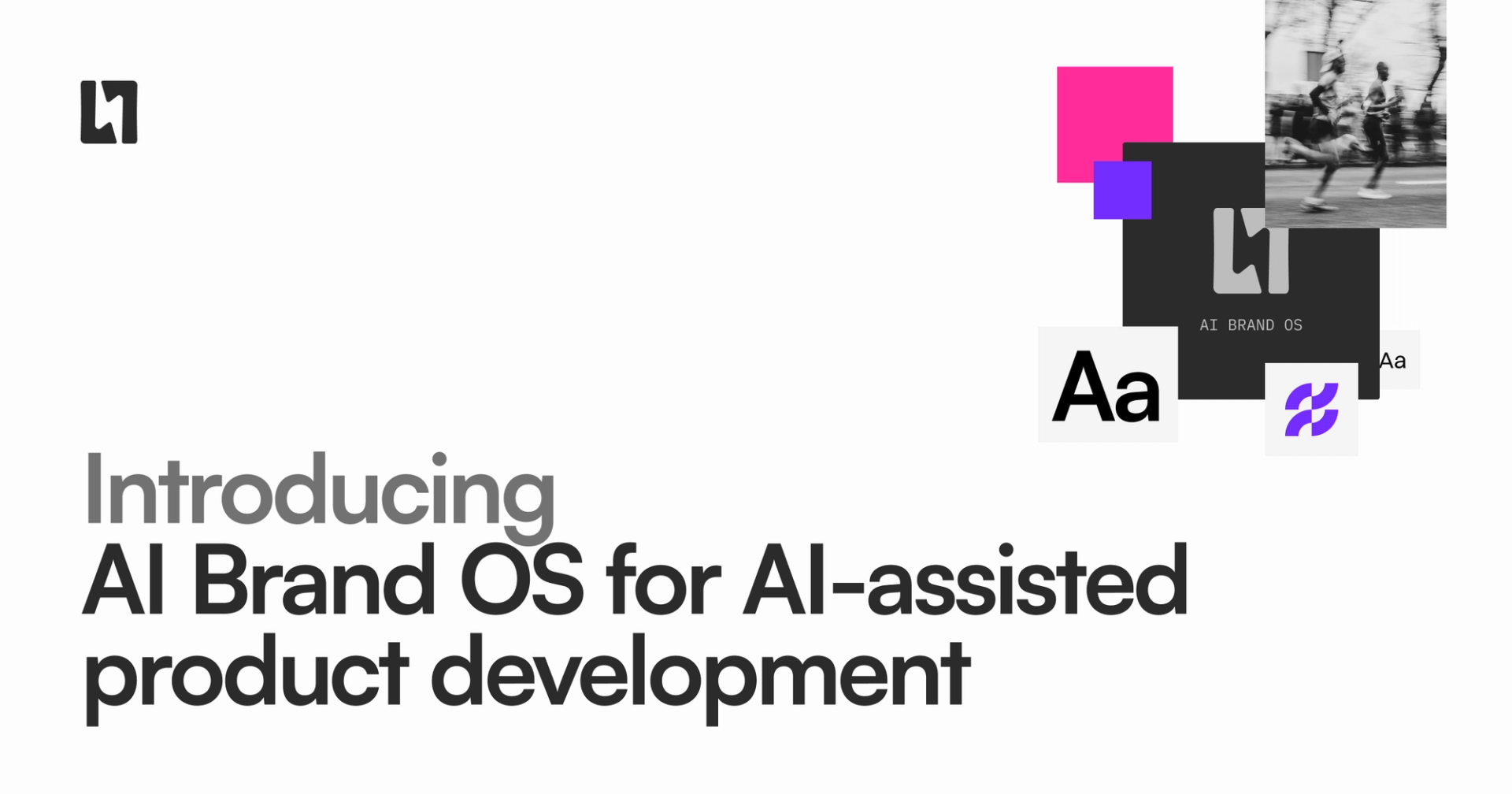
AI Brand OS is a one-off package that turns your brand into something AI agents can read and reproduce precisely. Not a PDF. Not a slide deck. A set of machine-readable markdown files plus a Figma design system library, written so that any modern AI or agentic coding tool can pick up your brand and build with it from the very first prompt.
In practice, that means your brand sits in context before the agent writes a line of code or generates a single image. The drift stops. The output ships. You spend your time on the bigger picture instead of correcting the same mistakes over and over.
It plugs into the tools founders are already using, including Claude and Claude Code, ChatGPT and Codex, Cursor and Lovable. Because the output is just well-structured files, the same approach works with effectively any platform that lets you supply context alongside your prompts.
Why not just upload your brand guidelines?
It's a fair question. The honest answer is that AI is poor at extracting precise information from images and PDFs. It guesses. It approximates your blue. It eyeballs your spacing. And when it guesses, you get a hallucinated version of your brand rather than the real one.
AI Brand OS gives the agent exact values instead: the precise tokens, the variables, the type scale, the easing curves, the references. There's no guesswork, so the outputs are consistently aligned with your actual brand. As an engineer, this is the part I care about most.
Specifics beat approximations every single time, especially when it comes to AI.
What AI Brand OS solves
In short, AI Brand OS saves time, money, effort and tokens.
With your brand codified and in context, the back-and-forth drops dramatically. AI-generated code references your real design system, which means less rework, fewer hard-coded one-off values, and more reuse of proper variables.
Marketing teams get landing pages, copy and imagery that are on-brand on the first attempt. And because there's no per-seat limit, you can hand the files to your whole team and every developer, marketer and agent works from the same source of truth.
How the process works, start to finish
I've kept this deliberately simple. There are three parts, and the first is optional depending on whether you already have a brand you're happy with.
01. Brand design (optional)
If you don't have a brand yet, or you want a fresh one, this is where we start. I'll present you with three single-page brand concepts, each going down a genuinely different visual route so you have real variety to react to. You pick your favourite and steer the direction, and I build that out into a full brand design system: logos, a colour scheme, a typography system, example imagery and graphics where relevant, and examples of common UI components. You get all of this in Figma.
If you already have a brand you love, we skip this entirely.
02. Codified design system
Next, I take the brand, whether it's brand new or your existing one, and codify it so it's ready to be used by both humans and AI agents. This is the translation layer that turns visual design decisions into exact, machine-readable rules.
03. AI-centric instructions
Finally, I go well beyond colours and type. I write dedicated instructions covering motion rules, tone of voice, and how your brand should be applied in different contexts, all based on your actual brand. These drop straight into Claude Code, Codex, Cursor and the rest. The whole thing is delivered within a month.
What you get
- A Figma design system library
- Codified brand design rules
- Functional examples of your brand in HTML
- Markdown files for all the popular LLMs, including ChatGPT, Claude, Cursor and Lovable
- Markdown files covering motion rules, tone of voice and more
Who AI Brand OS is for
AI Brand OS is most useful to founders, engineers and marketing teams who've adopted AI and agentic workflows for building products and running marketing.
If you're shipping with AI and you care about how the result looks and feels, this is built for you. And no, you don't need to be technical to use it. Once your brand is codified, you just drop the files into your chats or agent contexts. You're welcome to read every line if you want to, but you don't have to.
What it costs
It's a one-off purchase, not a subscription. If you already have a brand and just want it codified for AI, it's £999 (excluding VAT, if applicable). If you'd like a full brand design as part of the package, the total is £2,499 (excluding VAT). Payments are handled securely by Stripe.
FAQs
Which platforms does it work with?
It produces markdown and other file types that drop into pretty much any AI or agentic coding platform. I've seen great results in Claude (including Claude Code), ChatGPT (including Codex), Cursor and Lovable, and I'd expect the same anywhere you can supply context with your prompts.
How is this different to uploading an image or PDF of our brand docs?
AI struggles to pull precise information out of images and PDFs and ends up guessing. AI Brand OS gives it exact values, variables, easing curves and references, so there's no guesswork and no hallucinated version of your brand.
Is this a subscription or a one-off?
A one-off purchase. £999 to codify an existing brand, or £2,499 if you'd like a brand design included (both excluding VAT, if applicable).
Can I buy it for my whole team?
Yes. There's no limit on who can access the files and context, so you can share it across your entire team of developers, marketers and agents at no extra cost.
Does it help with code generation specifically?
Yes. AI-generated code references your branding when building new features and interfaces, which means less rework, fewer static one-off values, and more use of reusable variables.
What if I don't have a brand yet?
That's fine. I'll create one with you through the optional brand design step: three concepts to choose from, then a full design system built out from your favourite and codified for AI in the same package.
Get your brand ready for AI
If your agents are building your product, your brand should be guiding them from the first prompt, not getting bolted on afterwards. That's the whole point of AI Brand OS. If you'd like to talk it through, book a call about AI Brand OS, and we'll get your brand ready for the way you're actually building.