2027 is shaping up to be the year the software industry finds out which of its assumptions still hold.
Will AI continue to grow, or is the bubble about to pop? What impact will this all have on SaaS companies, and software as a whole?
This is the first post in our series on where SaaS and software are heading next year.
We've started with the open data we could find on funding, hiring, layoffs and the platforms people build on, and set it against what we see day to day running design and development support for founders and agencies across the UK, Europe and Asia.
The money behind the boom
Almost all of the growth in software right now runs through a handful of AI companies, and the money behind them is extraordinary.
Crunchbase counted $159 billion of global venture funding in Q3 2026, and $102 billion of it (64%) went to AI companies. A record 27 companies raised rounds of $1 billion or more in that single quarter, taking around a third of everything raised.
The labs at the centre of all this are, for the most part, not making money.
OpenAI burned through $3.7 billion in the first three months of 2026, on $5.7 billion of revenue, according to documents shared with shareholders and reported by The Information. A company presentation reported by the Financial Times projects $278 billion of negative free cash flow between 2026 and 2030.
Anthropic, which makes Claude, and is heading into an IPO soon, appears to still be loss-making on paper. Its IPO filing shows $33.2 billion of revenue in the first nine months of 2026 and a GAAP operating loss of $1.26 billion.
On its own adjusted measure it made $4.08 billion of operating income. The same filing lists $895.4 billion of purchase commitments and lease agreements, substantially all of it for compute and infrastructure.
Wall Street has started asking the obvious question. In October, Fortune reported that analysts expect AI spending to slow in 2027 as the industry heads towards a cash-flow negative inflection point.
Our prediction: AI funding could stall
There's a risk that AI funding stalls in 2027.
The whole stack, from the frontier labs to the thousands of start-ups built on top of them, depends on venture capital continuing to arrive ahead of profit. A disappointing IPO, or a large round that fails to close, would be felt by every company whose costs are priced in tokens. That doesn't have to mean a crash. It does mean the floor under this market is thinner than the headlines suggest.
LLM wrappers are running out of road
A lot of the AI start-ups funded in the last two years are, underneath, a well-designed interface on top of ChatGPT or Claude. That was a reasonable business while the labs were busy building models. It looks much riskier now.
Anthropic has spent 2026 going directly after business and enterprise work, adding plugins to its Claude Cowork tool for legal, finance and product marketing work. By mid-February, CNBC reported that the software sector had lost around $2 trillion of market value from its peak, a selloff it linked partly to the popularity of Claude Code and Claude Cowork.
OpenAI is pushing in a similar direction, but appears to be targeting the consumer market more strategically than the enterprise one.
Our prediction: wrappers will be at significant risk
In 2027, software that is essentially a LLM wrapper will be at significant risk.
If your product is a prompt, a nice interface and someone else's model, the company that owns the model can ship your feature as a setting fairly quickly, should they want to.
At the same time, the models keep getting better at writing software quickly, so the distance between "a product" and "something a customer can build themselves in an afternoon" keeps shrinking.
The wrappers that survive will own something the labs don't: proprietary data, a regulated workflow, a distribution channel or a community that trusts them.
Seat-based software loses its stickiness
For twenty years, one of the safest businesses in software has been a complex product sold per seat. Once a company had wired its processes into a CRM, a project tool or a website builder, leaving was painful and building a replacement was out of the question.
That stickiness was the moat.
But that moat is starting to look more like a puddle.
Over the last few months, a steady stream of the startups we work with have moved their marketing sites off hosted builders and onto code they own, mostly Astro and Next.js, so they can change them with tools like Claude Code. (We compared the options in Webflow vs Astro: which should you pick in 2027?)
Price is rarely the only reason. A founder can describe a new landing page and have a working version in minutes, in a codebase nobody charges them per seat for.
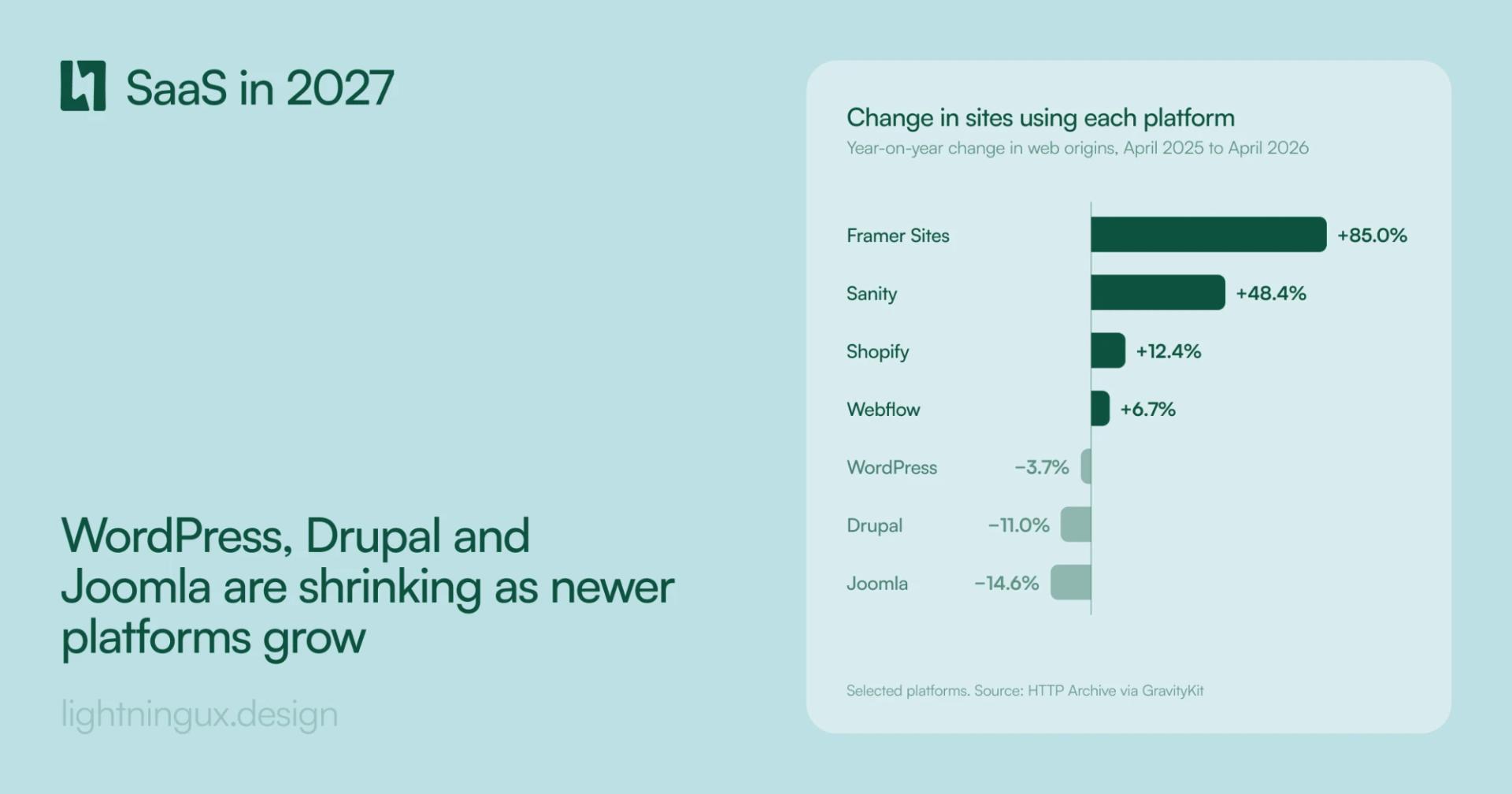
The open data points the same way, if not in a straight line. In the April 2026 HTTP Archive crawl, the number of sites on WordPress fell 3.7% year on year, Drupal 11% and Joomla 14.6%.
Newer platforms grew quickly: sites built with Framer (who adopted agents fairly rapidly) grew 85%, and sites using Sanity, a headless CMS that developers and AI tools can work with directly, grew 48%.
W3Techs puts WordPress at 39.2% usage of all websites as of 12 November 2026, and trending downwards. And in Stack Overflow's 2025 developer survey, use of React rose from 39.5% to 44.7%, and Next.js from 17.9% to 20.8%.
Our prediction: people build their own, and incumbents stall
In 2027, we expect more businesses will leave seat-based software and build their own tools, for internal workflows as well as websites.
That depends on two things: the AI bubble not bursting, and tokens staying affordable for the average user. Building your own custom software only makes sense if the model doing most of the work is cheap and still there next year.
If both hold, long-standing software companies that grew on how hard their product was to rebuild will start to see that growth stall. Most won't disappear. Many will change how they price, and some will become the platforms the new tools are built on.
But, fundamentally, complexity alone will no longer keep customers in.
What the jobs data says
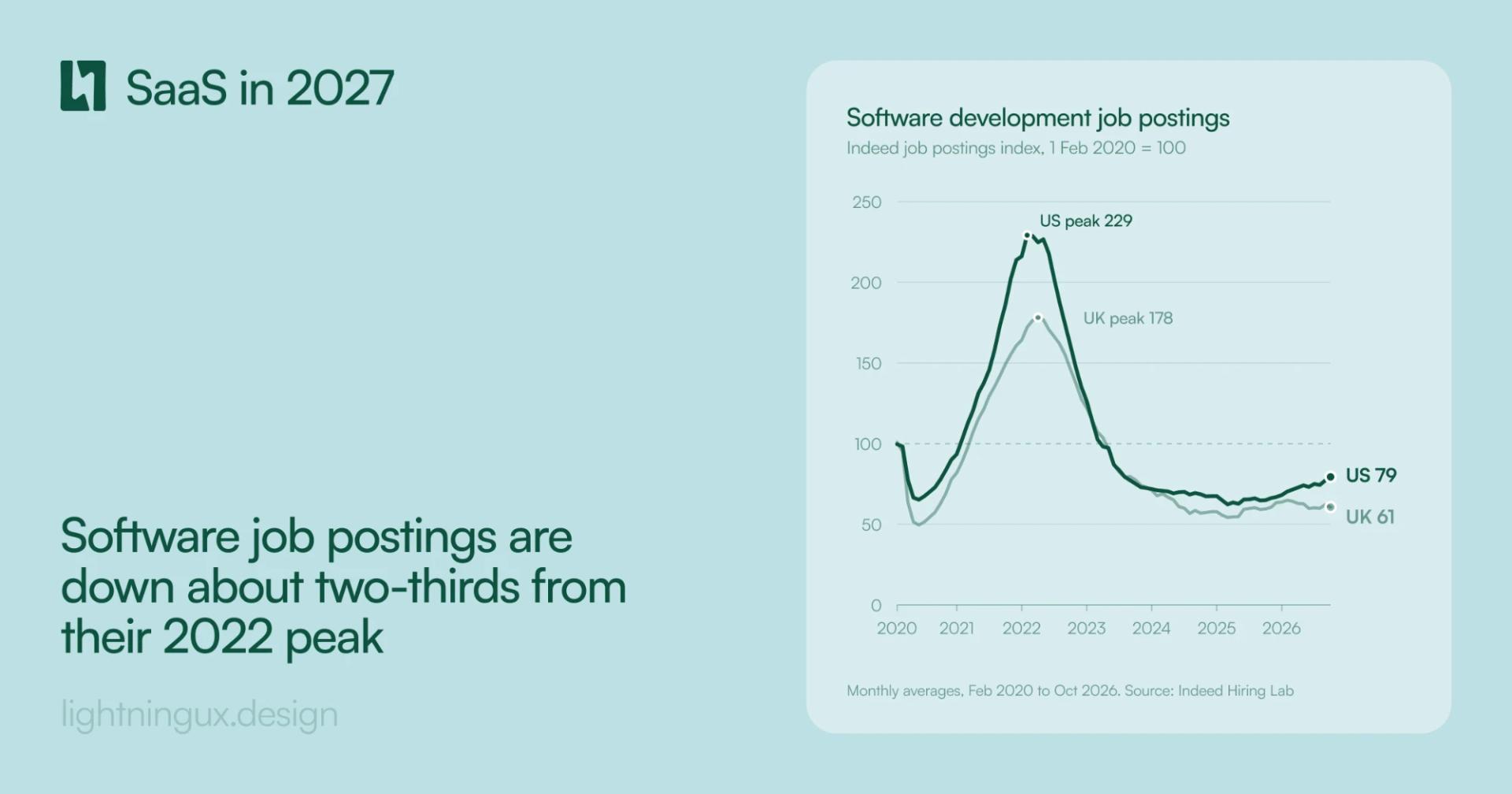
Hiring tells a similar story. Indeed's index of US software development job postings stood at 79 in October 2026 (February 2020 = 100), against a peak of about 229 in early 2022.
In the UK it stood at 61, against a peak of about 178. Senior roles made up 69.3% of US software development postings in Q1 2026, and entry-level roles just 4.5%.
Nearly half (47%) now mention AI.
Layoffs have kept coming. Layoffs.fyi had counted 142,512 tech workers laid off worldwide by 12 November 2026, already more than in the whole of 2025. Challenger, Gray & Christmas counted 155,126 announced US tech job cuts between January and August, up from 102,239 a year earlier.
Most agencies will be asked for more, for less
From signals we're seeing across the market, clients increasingly assume that a lot of agency work can be done, or at least started, by AI agents.
The expectations follow from that: shorter timelines, tighter budgets, and a first version that exists in days rather than weeks.
Our prediction: faster, cheaper, and more clients
In 2027, clients of typical agencies will expect work faster and cheaper, and agencies will have to adapt. The ones that do well will rebuild their process around agents, deliver in smaller and quicker increments, and take on more clients at once. That's a different business from billing a few large retainers, and it needs different tools, pricing and people.
Of course, there will still be enterprise clients who expect complex work to take time, but the majority of small to mid-level companies looking for agency work will have a new mental model of how long work takes to get done.
The case for human-made work
The other side of the coin is that as AI content has flooded feeds, inboxes and search results, people have noticed (and somewhat ignored).
Merriam-Webster named "slop" its 2025 word of the year, defining it as low-quality digital content produced in quantity by AI. In a Gartner survey of US consumers published in September 2026, 65% said brands are producing too much AI-generated marketing content, and 57% said it has made them trust brand messaging less.
Our prediction: a revival for human creativity
In 2027, human-centred creativity and writing could make a comeback as people tire of obviously AI-generated content.
We think some agencies and creatives will go all in on human work, with no part of the job handed to AI, and make that a clear, unique selling point.
A site, a brand or a piece of writing that a person clearly thought hard about will feel different, because so little does. And because that work is slower and scarcer, those studios may be able to charge more than is typical, not less, and deliver it with longer lead times.
That leaves agencies at a fork.
One path is fast, affordable and agent-led, serving more clients.
The other is slower, entirely human and premium.
Both can work. The risky place to be is in between: charging human prices for work that looks like it came out of a prompt.
Our predictions for 2027, in short
- Apps that are essentially LLM wrappers around ChatGPT and Claude will be at significant risk as the labs move into the business of building software.
- AI funding could stall, because the frontier labs driving the growth are still spending far more than they earn.
- More businesses will leave seat-based software and build their own, as long as the bubble holds and tokens stay affordable.
- Long-standing SaaS companies that relied on stickiness and complexity will see growth stall.
- Human-made creative work will make a comeback, and the studios committed to it may charge a premium.
- Clients will expect agencies to deliver faster and cheaper, and agencies will serve more clients to make that work.
What's next in this series
We might be wrong!
This is the first post in our series on where SaaS and software are heading in 2027.
Next, we're talking to other founders in the industry to hear what they're seeing in their own markets, where they think we're right, and where they think we're wrong. Stay tuned for those.
Figures checked at the time of writing, in November 2026, by me and my pal Opus 5.5.