Earlier this month we published our predictions for where SaaS and software are heading in 2027. We ended it by admitting we might be wrong, and promising to ask the people who'd know.
This is the first of those conversations.
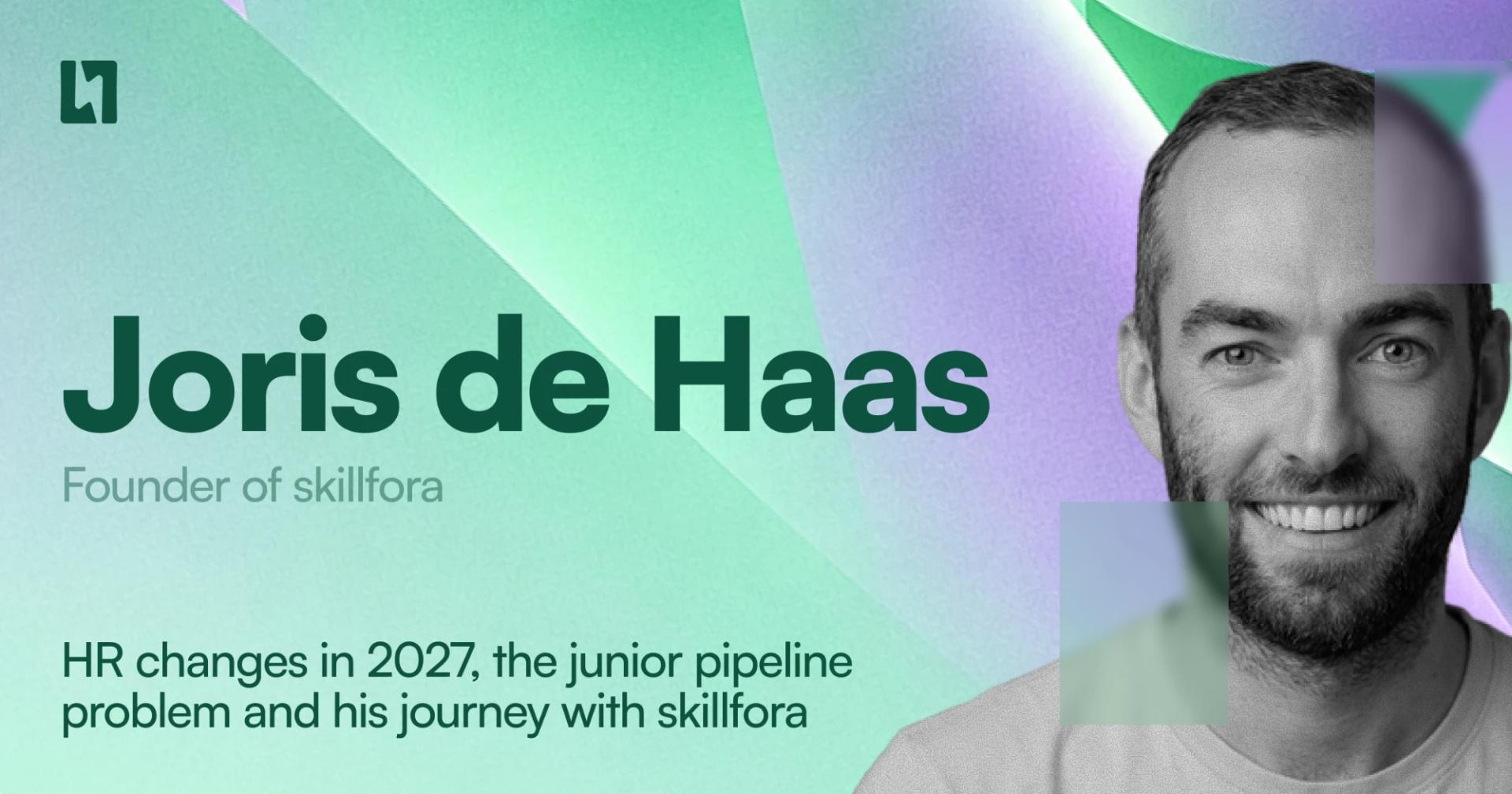
Joris de Haas is the founder of skillfora, a platform that helps mid-market companies understand the skills and capabilities of their workforce.
He's Dutch, has lived in Budapest for the last four years, and spent the ten before founding skillfora in HR tech, working as a business partner with companies of anywhere from 500 to 20,000 people.
Joris and I worked together on bringing skillfora to life this year, so I've seen how he works up close. He's one of the few founders I've worked with who turned up with the product already half-explained.
We talked about how he got skillfora off the ground with tiny team, why he thinks this year's rush to build software in-house will turn back into buying it, and what happens to an industry that stops hiring juniors.
Starting with a prototype, not a brief
Let's start with you. What made you want to build skillfora?
I spent ten years in HR tech and got frustrated with how we work with HR systems. A lot of workflows are done manually, or very poorly, in systems the business and its people barely use. And those systems often can't handle the specific use cases around skills, challenges and growth.
So I started thinking about what I thought was missing in the mid-market, which tools and platforms were already out there, and where there was a niche problem I could solve and build from.
When we first spoke, you'd already built a working prototype in Figma Make. That was one of the first times a founder had come to me and said "here's basically how it works", rather than asking me to build the prototype so we could check our visions lined up. It felt like you'd arrived on one of those moving walkways at the airport. Why start there, rather than going to designers or a consultancy?
I'd been talking to a product engineer in the US who couldn't take it on because he had other work. He told me to just vibe code it. So I did.
I used Figma because I'd used it at my previous company, just for random stuff. I'm not super proficient, but I figured if they'd added vibe coding it would be better than the other tools out there. And I didn't have any money, so it made more sense to build something myself and show it to people.
It was also a better way to explain what I wanted. I could show a consultant or a design engineer my vision through a vibe-coded platform, which was really ugly, instead of sending them 30 pages.
But you felt there was still a need to build it properly?
Some people will tell you to vibe code it, share it with a few people and see if it works, and I agree with that up to a point. But if you really want to put something in the market, you need to show a proper platform.
We built the MVP, including the design and the logo, in less than two and a half months, and I've been using it in sales calls for two months now.
People don't see it as a vibe-coded platform. It's properly built, so they feel safer going into a possible design partnership. And once we sign, I can get an integration layer started within two weeks instead of spending two months building it out.
The team you need now
You've talked about teams getting smaller. You don't necessarily need a friends and family round any more: you can build a product for a few thousand pounds with a very small team. How did you work out what you needed?
Mostly from the ten years I'd already spent seeing how not to do it. But all the research I'd done and the podcasts I follow, Lenny's included, because he always interviews really interesting people, said the same thing: you don't need a big team any more. What matters is taste, systems thinking, and understanding people and their friction points.
So I could build an MVP with one design engineer, someone who bridges design, software engineering and product, plus UX of course. A founder and one person. That's just insane.
And who comes next?
I'm looking for paid design partners now, and when I have the money I'll bring Michael back in. Next to him I need an architect or a security engineer, partly because Michael told me early on that it was necessary. Up until about five customers I don't think we need anyone else.
After that it's a data scientist with experience in AI models and workflows, and then a go-to-market expert. In my experience that's the most important person when you want to kickstart the business, because there's so much noise.
Everyone can build their own vibe-coded platform. But if you want something rock solid, maintained, with governance in place, companies will still need that, and you have to take it to market. That's a mix of GTM engineering and old-school sales, done in a more authentic way.
Build it, then buy it back
In our first post we predicted more businesses would leave seat-based software and build their own. What are you seeing?
Inside companies, people try to build something themselves first. Once they've built it, they realise someone needs to maintain it and put security and governance in place, so those teams get bigger. And at a certain point, if the capabilities of their own people aren't on par, they need to bring in consultants.
SaaS isn't changing as such. It's still software as a service, but the service part will get bigger. Then companies realise it's actually quite expensive to do all of this in-house, and they buy instead of building.
This year was all about building, because people thought they could build their own recruitment system. You can't. You can't match the features of a proper system that's been around for 20 years and is now moving the needle with AI workflows and automation.
It's easier to build something, but it's more difficult to build something meaningful.
So I think 2027 is when people realise, faster, that it isn't sustainable to build and maintain everything yourself. There are costs to that, and sometimes it's cheaper to buy.
The trade-off I hadn't considered is what happens at scale. A company builds its own recruitment tool to get away from the pricing and the janky functionality, and to an extent builds a moat, because nobody else has software that fits their workflows so well. Then it's handling 10,000 applicants a day and running into all the production problems the vendor used to handle for them. Do they go back to buying, or start competing with the products they replaced for the same engineers?
There's a reason OpenAI is now paying people to help get AI into businesses, with OpenWorks. In the end, a company is information flows and people, and people will always be the bottleneck. Adoption is already slower than the speed of the models. OpenAI knows that from its data, and Anthropic is doing the same.
Look at Salesforce. They had their own experts, but Salesforce experts were also on the payroll of their customers. I think those teams get smaller too. Companies are already looking at what they pay for their SaaS platforms and whether they bring value, and now they're tracking AI usage and whether it makes an impact. Everything is being looked at through cost and impact.
Hiring changes with it. You don't hire someone just to fix a problem any more. You look at what that person costs, which is now base salary plus AI usage. So in 2027 I think companies will look at their systems deliberately. What does it cost? What's the impact? Should we build it, and how long will that take? Do we have the capability in-house? If not, we need to hire.
Even knowing whether you have the capability takes time, and that's what I'm solving with skillfora. Right now it lives in the heads of managers. If you track the capabilities of your workforce, you can see the answer much quicker.
And when they decide to buy?
Then they work very closely with the people building the platform and tell them what to build. That's where SaaS needs to change: not only bringing the platform, but understanding the customer and building something relevant. SaaS tools need to be able to adapt to different kinds of companies.
Which is far more realistic now. At a startup I used to work at, a customer asking for a specific feature meant a headache and a lot of work. Now, depending on scope, you could probably deliver it in a week or two.
It used to take weeks just to send a ticket and get someone to pick it up. Now it's days.
Agents, and who keeps an eye on them
People are increasingly competing with agents. Say you've built your own alternative to Salesforce and need to secure it. You could hire a security specialist, or give the engineer you already have an agent that specialises in security and see how far they get. Is comparing people with agents something skillfora might do?
There are platforms that help companies structure their agents, so they know exactly what each one does, what it costs and who built it. Some companies have thousands, and they all need maintaining. Who does that?
I haven't solved that piece. I can only solve it by working with design partners, and that's what SaaS companies need to do: be very close to customers and understand not just what to build, but why. That's why product and design are going to be so important. I have no clue yet what it looks like, but it's all about the context layer.
The trend I think I can see isn't general models getting bigger and smarter, but smaller models trained on one function that can operate like a person. Something incredibly good at AWS, say. An engineer gets stuck deploying, hands it to the agent, gets unblocked and carries on. And as context windows grow, it could understand how a whole environment fits together faster than someone who'd need three months just to onboard.
Which again means reshuffling what we expect of an engineer.
That's already happening. In January, writing code by hand was a fundamental part of the job. Going into 2027, I'd say it isn't really. Agents are very good at writing code. You need to tell them what to write, and notice when they're going down the wrong route.
But that's the thing. You need engineers who understand when the AI or the agent isn't doing it properly. If you don't have that knowledge in-house, whoever does will be more capable than you.
The junior pipeline problem
That leads to something I wanted to ask you specifically. Zoe Scaman wrote about the pipeline problem on her Substack, Musings of a Wandering Mind. Global job postings asking for zero to two years' experience have dropped an average of 29% since January 2024. Early-career workers in the roles most exposed to AI have seen a 13% relative decline in employment over three years. And the average new hire in the US is now 42.
Give a mid-level or senior person AI and it's like adding ten people to your team. But you only learn to spot when something's wrong after years of experience. If graduates can't get a job, how do they get that experience? It's not a problem today, but in five or ten years there are no new seniors.
In ten years it is a problem. A few years ago I worked in a technical industry: blue-collar work on the ground, fixing real pipelines, like water pipes, not engineering pipelines. 80% of the workforce was close to 65.
In five years they'd have had a huge problem without new people coming in. So we put fresh graduates next to people with 30 or 40 years' experience, so all that knowledge didn't get lost. I think tech needs to do exactly the same.
People always complain about Gen Z, but I think they're super smart. They ask the right questions and they don't take no for an answer. The good companies that bring them on board and put them next to their most senior engineers will be more valuable, earn more and have more impact for their customers than the ones that skip this over the next few years.
The good companies that bring them on board and put them next to their most senior engineers will be more valuable.
Physical industries often have apprenticeships, sometimes subsidised by the company and sometimes by the government, to raise skills across the population. Do governments have a responsibility to get young people into jobs, even when it doesn't help a company's bottom line?
100%. Some countries already make it mandatory to have a certain number of people per headcount who are associates, or who come from a tough background, so they can get into the job market. Governments play a big role here. If they don't, we could end up with a huge issue in the future, and a big issue for the economy.
There's an opportunity for skillfora there too. You could show not only the skills in a company, but where they sit on the seniority ladder, and whether you need more juniors coming up behind them.
That's the idea. Once you set out what you expect of your people in terms of skills, and the platform is intuitive enough to keep that up to date with what you actually need, you know exactly what's changing. Build it so you can look back over the history, and you see exactly what's happening inside your company. At the moment I only see companies doing that at enterprise level.
Final prediction for 2027
Honestly, I think things will slow down a bit. Companies will start thinking more carefully, and stop assuming AI can take over everything. I think that's already been happening over the past three months.
What we took from it
In our first post we said more businesses would build their own software in 2027. Joris agrees the building will carry on, but thinks a lot of it comes back to buying once the maintenance, security and governance bills arrive.
That's a fair correction. Building your own was never only a question of whether you can. It's whether you can keep it running.
Where we agree completely is juniors. As we noted in part one, data shows entry-level roles made up just 4.5% of US software development postings in Q1 2026. If the people who can tell when an agent has gone wrong are the ones with years of experience, an industry that stops hiring juniors is quietly running down the thing that makes AI safe to use.
And the way skillfora got built probably says as much about 2027 as anything here: a founder with a vibe-coded prototype, one design engineer, and an MVP in front of customers in under two and a half months.
What's next in this series
Next, we're talking to another founder about what they're seeing in their own market, and where they think we've got it wrong. Stay tuned.
Thanks to Joris for his time. You can find out more about skillfora at skillfora.io.